
Intel introduced the LGA 1200 socket (Socket H5) alongside its 10th Gen Core CPUs and carried it into 11th Gen, retiring LGA 1151 for those platforms. For cooler upgrades, LGA 1200 is a painless transition because it uses the same 75 mm x 75 mm mounting hole layout as the older LGA 115x family. In practice, that means most LGA 115x air coolers and AIOs fit on LGA 1200 boards without any new brackets.
You can find my recommended LGA 1200 coolers below:
Recommended LGA 1200 Coolers
for a specific LGA 1200 CPU:
Considerations When Choosing a CPU Cooler

Thermal Dissipation
A CPU cooler's TDP (Thermal Design Power) rating indicates how much heat it can dissipate in watts. If the cooler can't keep your CPU cool enough, your CPU may throttle (slow down), and your cooler will constantly run at full speed.
Intel CPU specifications indicate this power dissipation number as "Processor Base Power" and "Maximum Turbo Power."
For example, the Core i9-12900K has a TDP of 125–241 watts, depending on the workload.
A CPU cooler can still work with a lower TDP rating than the TDP of a CPU. However, the CPU will eventually throttle itself to a lower frequency to allow itself to cool.
The CPU may not achieve or maintain maximum turbo speeds without adequate cooling.
Types of Coolers
Air coolers use a combination of heatsinks and fans. They are the cheapest, but also the loudest.
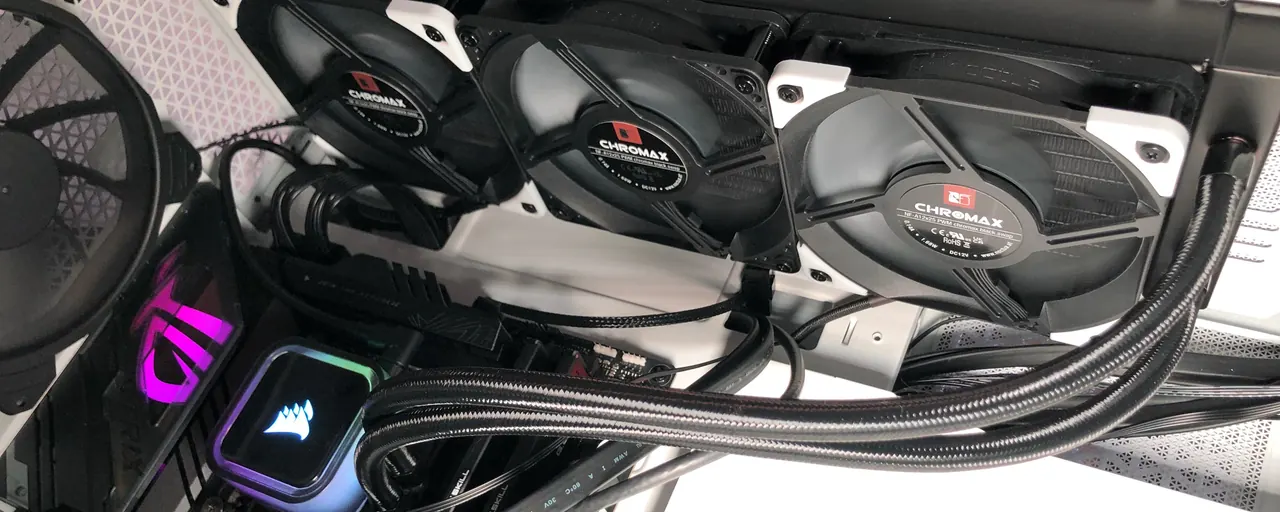
A Closed-Loop Cooler (CLC), also called an All-in-One (AIO) cooler, is a type of liquid cooler. All-in-one liquid coolers provide a more straightforward setup in a single pre-built package.
Liquid cooling can provide even better TDP performance at lower noise levels but are more expensive and take up more room. The noise level and ability to cool your CPU will depend on the liquid cooling solution's radiator size and the number and size of the fans.
Open-Loop Coolers are also a type of liquid cooler, except you construct them yourself. They allow for more flexibility in building your perfect cooling solution but can also be more complicated to set up. Open-loop systems give you the flexibility to cool additional devices, such as your graphics card's GPU.
Noise
More fans typically mean better cooling. However, they also mean more noise.
Larger fans are typically quieter than smaller fans, as they can move the same amount of air at lower speeds.
If a cooler is struggling to cool a CPU, it will run at its maximum speed, which will be louder.
Fan noise levels are measured a dB. Lower dB values are quieter.
You can often configure your motherboard's BIOS to use specific fan speeds at particular temperatures. This configurable fan speed allows you to have a near-silent computer while your computer is idle.
Mounting Brackets
CPU coolers can have various mounting brackets to work with different socket sizes. Make sure that your cooler comes with a compatible mounting bracket.
The easiest way to find a CPU cooler that will work for your computer is to search by socket type. For example, Intel's 12th generation Core i9 12900K uses an LGA 1700 socket, so you would search for an LGA 1700 CPU cooler. In some cases, such as when a new socket size is released, there may not be many compatible coolers. In these cases, you can often purchase a separate mounting/
Size
Before buying the biggest cooler possible, ensure that your case and motherboard configuration have room.
Also, ensure that other components on your motherboard won't interfere due to size constraints. For example, do your memory modules (DIMMs) have tall heat spreaders?
Dual-fan coolers often take up quite a bit of room. Liquid cooling solutions typically position fans at the top or bottom of the case.
Lighting
Some CPU cooler fans come with LED lighting. Similarly, liquid cooling pump heads can also come with LEDs or even LCDs!
If you want to turn off the lights when they get annoying, make sure your CPU cooler has that option.
Price
In general, air-based coolers will be lower cost than liquid cooling systems.
CPU coolers that support a higher TDP are also typically correlated with a higher price.
The more advanced lighting features tend to also come at an extra cost. You can decide between a practical, low-cost solution and a dazzling light show.
Recommended LGA 1200 Coolers
Locked Intel CPUs are typically bundled with a stock CPU cooler and are identifiable by the absence of the "K" in their model name. While these coolers are adequate for preventing the CPU from overheating, they may limit the processor's performance during demanding tasks such as gaming. Additionally, stock coolers may produce noticeable noise when running at maximum speed.
A higher TDP cooler is recommended to sustain the peak speeds for extended periods to ensure optimal performance.
Best LGA 1200 AIO Liquid Coolers
ARCTIC Liquid Freezer III Pro 360
ARCTIC Liquid Freezer III Pro 360 Supports LGA 1200: With MPSAS01117A kit Radiator: 360 mm, 38 mm thick Fans: 3 x 120 mm Type: Liquid Cooler Check the latest price of the ARCTIC Liquid Freezer III Pro 360 on Amazon

Choose this 360 mm AIO for a build with room for a large radiator, such as a CPU-heavy workstation. The three 120 mm fans move heat out through the radiator; the pump and fans support PWM control.
Supports AM4, AM5, LGA 1700 and LGA 1851. The 38 mm radiator is thicker than many AIO radiators; check radiator, fan and motherboard clearance in your case.
LGA 1200/
115x requires the separate ARCTIC MPSAS01117A mounting kit . Order the 1200/115X kit with the cooler for these sockets.
Best LGA 1200 Dual-Fan Air CPU Coolers
Thermalright Phantom Spirit 120 SE Black
Thermalright Phantom Spirit 120 SE Black Supports LGA 1200: YES Height: 154 mm Fans: 2 x 120 mm Heatpipes: 7 Check the latest price of the Thermalright Phantom Spirit 120 SE Black on Amazon
A dual-tower air cooler with seven heatpipes and two PWM fans. Choose it for a fan-cooled build without a liquid-cooling pump or RGB wiring.
Supports AM4, AM5, LGA 115x, 1200, 1700 and 1851. Allow 154 mm of case clearance, plus any extra height needed if the front fan must be raised above tall RAM.
Noctua NH-D15
Noctua NH-D15 Supports LGA 1200: YES Height: 165 mm Fans: 2 x 140 mm Max. fan noise: 24.6 dB(A) Type: Heatsink & Fans Check the latest price of the Noctua NH-D15 on Amazon
A premium dual-tower air cooler with two 140 mm PWM fans. Choose it if you prefer Noctua's fan design, mounting hardware and six-year warranty.
Check the 165 mm case clearance and RAM height; raising the front fan above tall modules increases the space required. Older packages may need the appropriate mounting kit for newer sockets.
Thermaltake TOUGHAIR 510
Thermaltake TOUGHAIR 510 Supports LGA 1200: YES Max TDP: 180 watt Type: Heatsink & Fans As someone who isn't a big fan of flashy LED lights, I appreciated the simplicity of the Thermaltake TOUGHAIR 510, which doesn't have any fancy lights but still looks great in my system.
I found that the dual 120 mm fans on the TOUGHAIR 510 did an excellent job of keeping an LGA 1200 CPU cool, even under heavy workloads.
If you're worried about the TOUGHAIR 510 taking up too much space in your system, Thermaltake offers a few single-fan variants that use different orientations, so you can choose the one that works best for your setup.
With a max speed of 2000 RPM, the TOUGHAIR 510 provides optimal cooling performance when you need it most.
With a 180-watt TDP (Thermal Design Power), the TOUGHAIR 510 offers solid cooling performance and is a great choice for anyone looking for a reliable and efficient cooling solution for their CPU.