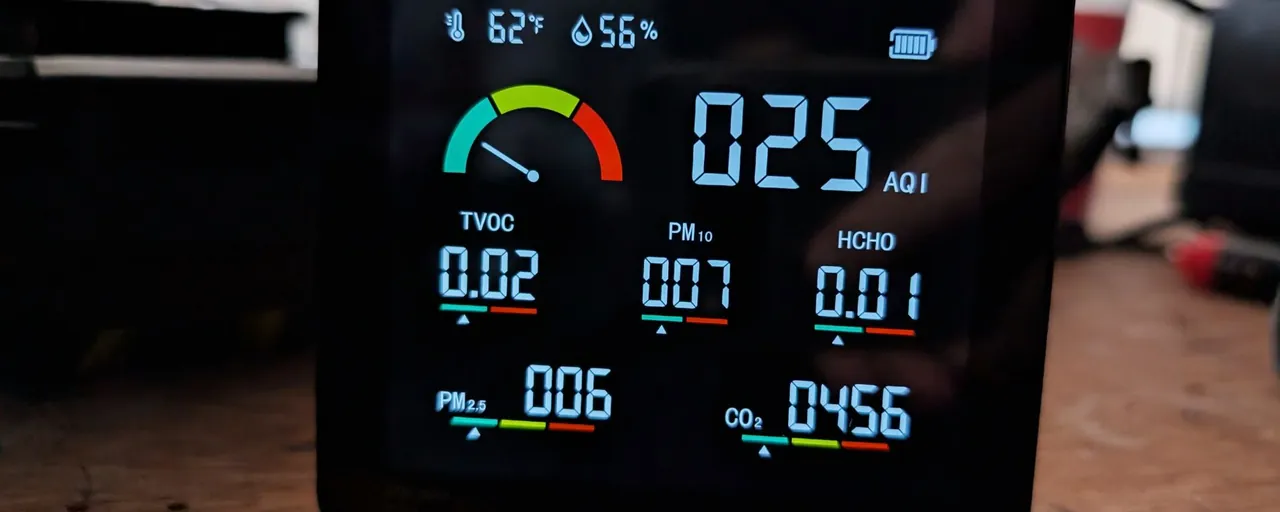

Modern homes and offices generate indoor pollutants from activities such as cooking, cleaning, and nearby traffic. A reliable air quality monitor provides precise data on these invisible particles, enabling informed decisions about ventilation, air purification, or safety measures.
For our recommendations, see Our Recommended Air Quality Devices below.
Common Scenarios

Select the scenario below that aligns with your needs to determine your starting point.
Stale Home Office or Afternoon Fatigue
If you experience reduced focus or stuffy air, choose an indoor monitor that measures Carbon Dioxide (CO2), temperature, and humidity. Monitor CO2 levels exceeding 900 ppm or spikes in Volatile Organic Compounds (VOCs) after cleaning.
Wildfire Smoke or Urban Dust
For homes in high-pollution areas, select a monitor that tracks PM2.5 (fine particulate matter) and pair it with a HEPA purifier sized for your room. Consider an outdoor sensor to compare indoor and outdoor air quality. Track how quickly your purifier reduces particle levels during smoke events.
New Furniture or Chemical Odors
Renovations and new furnishings release chemical compounds. Use a monitor with a VOC sensor and a purifier with a carbon filter. Evaluate how effectively ventilation clears these compounds after projects.
Safety or Regional Risks (CO, Radon)
Safety monitoring is separate from air quality. Install certified Carbon Monoxide (CO) alarms on every level near bedrooms and place a radon test kit or monitor on the lowest occupied floor.
Planning Your System
Identify your primary concern before selecting sensors. For most households, the initial monitor should measure PM2.5, true NDIR CO2 (a more accurate type of CO2 sensor), VOCs, temperature, and humidity. These metrics provide feedback on the effectiveness of ventilation and filtration.
Purchase Priority
Acquire equipment based on impact. Begin with a reliable indoor monitor for your main living space. Next, add a HEPA purifier for the room with elevated particulate matter. Ensure certified CO alarms and a radon test kit are in place. Optionally, add an outdoor sensor for areas with heavy traffic or smoke.
Align Sensors with Objectives
For sleep and focus, prioritize an NDIR CO2 sensor. For smoke or dust, emphasize PM2.5 accuracy and HEPA filtration. For chemical odors, VOC sensors are critical. Combustion safety requires certified CO alarms, and radon risk necessitates dedicated testing.
Standard Setup for Most Homes
A typical starting setup for many homes includes:
- One indoor monitor in the primary living area that measures PM2.5, NDIR CO2, VOCs, temperature, and humidity
- A HEPA purifier for the room with the highest dust or smoke levels (often the living room or a bedroom)
- Certified CO alarms near bedrooms and on every floor
- A radon test kit or monitor on the lowest occupied level
You can expand from this baseline if you have special concerns such as severe allergies, frequent smoke events, or a basement bedroom.
Quick Start Guide
Follow these steps for immediate setup without extensive research.
1. Purchase a Quality Indoor Monitor
Choose a device that measures PM2.5, NDIR CO2, VOCs, temperature, and humidity. Avoid devices that only display temperature and humidity without air quality metrics.
2. Monitor Your Main Area for One Week
Place the device at breathing height, away from windows, stoves, and humidifiers. Observe how readings change during cooking, sleeping, or hosting guests. Note VOC spikes after cleaning or introducing new items.
3. Determine Next Steps
If CO2 levels remain high, improve ventilation or airflow. If PM2.5 increases during cooking or smoke events, add HEPA purifiers to affected rooms. For basement bedrooms, conduct a radon test promptly.
Placement Guidelines
Proper placement ensures accurate readings.
Living Room or Open Plan
Position the monitor at breathing height, away from corners, vents, or humidifiers. Operate purifiers on low or medium settings during normal conditions, increasing speed during cooking or pollution events.
Bedroom
Place the monitor on a nightstand, ensuring it is not obstructed by pillows or humidifier mist. Use purifiers on a quiet setting overnight. Monitor CO2 trends to assess whether to open a window or leave the door ajar.
Home Office
Position the monitor near your desk, avoiding direct fan airflow. Use CO2 levels to schedule fresh air breaks. Watch for VOC spikes after using printers or cleaning products.
Outdoor or Window PM Sensor
If using an outdoor sensor, place it in a sheltered location near a window. Shield it from direct rain, direct sun, and cooking exhaust vents. Compare indoor and outdoor readings to optimize ventilation timing.
Safe Levels for Air Quality
Use these ranges for general home safety, comfort, and trend monitoring.
PM2.5 (micrograms per cubic meter)
Aim for 0 to 5. Levels of 5 to 15 are acceptable for most homes. From 15 to 35, consider running your purifier on a higher speed, improving range hood use while cooking, and checking for dust sources. If readings exceed 35, enhance filtration, close windows during outdoor pollution events, and identify the source.
PM10 (micrograms per cubic meter)
Aim for 0 to 15. Levels of 15 to 30 are usually acceptable. From 30 to 50, increase ventilation and use air filtration, especially if you notice symptoms or dust buildup. If readings exceed 50, treat it as a pollution event: close windows if outdoor air is poor, run filtration on higher speed, and look for sources such as construction dust or heavy sweeping.
CO2 (parts per million)
Effective ventilation maintains levels between 400 and 800 ppm. Levels of 800 to 1200 ppm may feel slightly stuffy. At these levels, open a window for a short period, take a fresh air break, or leave doors open between rooms. Above 1200 ppm can cause drowsiness and reduced focus, and over 2000 ppm requires immediate ventilation improvements, such as opening windows more widely, reducing occupancy in the room, or running mechanical ventilation if available.
TVOC (parts per billion)
Aim for less than 150 ppb for routine living spaces. Levels between 150 and 500 ppb are generally acceptable for short periods, but if they stay in this range, consider more ventilation and reducing sources such as strong cleaners, fresh paints, or new furniture. From 500 to 1000 ppb, increase ventilation, avoid new VOC sources, and see if readings drop after airing out. Above 1000 ppb, treat as a high level: ventilate strongly, remove possible sources, and consider more detailed testing if levels do not come down.
HCHO / Formaldehyde (parts per billion)
Aim to keep long term levels below about 30 ppb. Levels between 30 and 60 ppb are common indoors but worth watching if they persist, especially in new or recently renovated spaces. From 60 to 100 ppb, increase ventilation, avoid adding new pressed-wood products or strong adhesives, and consider source control. If readings repeatedly exceed 100 ppb, treat this as high for a home setting and look into targeted mitigation or professional assessment.
Radon (picocuries per liter)
Aim for the lowest level you can reasonably achieve, ideally under 2 pCi/L over long term testing. Between 2 and 4 pCi/L, plan mitigation, especially if this is a long term average. At 4 pCi/L or above, health agencies recommend taking action, such as hiring a qualified radon professional to design and install a mitigation system. Always base decisions on properly conducted long term radon tests.
About Accuracy and Calibration
Consumer air quality monitors do not always match regulatory or lab-grade instruments exactly. Expect some difference in absolute numbers between devices and weather stations. For home use, focus on trends over time and relative changes between activities, rooms, and before or after ventilation or filtration changes. That pattern is usually more useful than chasing exact numbers.
Our Recommended Air Quality Devices
These picks prioritize wide availability, reliability, and comprehensive sensor coverage for most homes.
Stand Alone Indoor Air Quality Monitors
Aranet4 Home Indoor CO2 Monitor
A battery powered CO2 monitor with an e ink display that is popular for tracking ventilation quality at home, in offices, and in classrooms.
- Uses a high quality NDIR sensor to track CO2, temperature, relative humidity, and atmospheric pressure in real time.
- E ink screen and cable free design deliver multi year battery life, so you can leave it running in the background.
- Connects to the Aranet Home app to review historical trends and configure alerts when CO2 rises above healthy thresholds.
Coiliiot Indoor Air Quality Monitor
A compact all in one desktop monitor that tracks multiple indoor pollutants plus basic comfort conditions.
- Monitors CO2, formaldehyde (HCHO), TVOCs, and fine particles (PM2.5/PM10) along with temperature and humidity.
- Provides a real time indoor air quality index so you can quickly see when ventilation or filtration is needed.
- Sized for home and office rooms and easy to move between desks, bedrooms, and living areas.
Temtop Advanced Air Quality Monitor (M2000C 2nd)
A handheld, professional grade monitor focused on CO2 and particulate pollution with built in data logging.
- Measures CO2, PM2.5, PM10, temperature, and humidity using high precision sensors designed for indoor air assessments.
- Color TFT display, audio alarm, and simple controls make it easy to see and hear when levels cross your chosen thresholds.
- Rechargeable and portable with USB data export so you can capture long term trends for homes, classrooms, or small businesses.
Professional Indoor Air Quality Monitor With AQI Beep Alarms
A feature packed tabletop monitor that combines many sensors with loud AQI alarms for an all in one indoor snapshot.
- 16 in 1 sensor suite tracks particulates (PM1.0, PM2.5, PM10), CO2, TVOCs, formaldehyde, temperature, and humidity, then rolls everything into an AQI style score.
- Large color display and one button controls keep readings easy to read while making it simple to switch units and mute alarms.
- Portable, battery powered design with a rechargeable lithium battery that suits home, nursery, car, or office air checks.
Air Purifiers With Built In Monitoring
IQAir HealthPro Plus XE Air Purifier
A high performance purifier for larger spaces that pairs medical grade filtration with smart air quality monitoring.
- HyperHEPA and V5 Cell filtration capture ultrafine particles down to 0.003 microns plus gases and odors, suitable for allergy, asthma, and wildfire smoke concerns.
- Designed for rooms up to roughly 1100 square feet with a quiet, energy efficient fan that runs at about 35 dB on lower settings.
- Built in smart sensors and Wi Fi connectivity let you track real time indoor air quality and control the unit remotely through the companion app.
CO Alarms
Kidde Battery Operated Carbon Monoxide Alarm (KN-COPP-B-LPM)
A compact, battery powered carbon monoxide alarm with a digital display for whole home protection without any wiring.
- Uses an electrochemical sensor to continuously monitor for dangerous CO levels and sounds an 85 dB alarm if gas is detected.
- Backlit digital screen shows current CO levels in parts per million and stores the highest level detected with a peak level memory function.
- Runs on replaceable AA batteries for protection during power outages, with test and reset button, status LEDs, and a battery lockout feature that helps prevent installation without batteries.
Radon Monitors
Aranet Radon Detector for Home
A portable radon and indoor climate monitor with an e ink display and companion app for tracking long term exposure.
- Provides real time radon readings along with 24 hour, 7 day, and 30 day averages, and also tracks temperature, humidity, and air pressure in the room.
- Delivers a first radon reading in minutes and is designed for multi year battery life, so it can stay in place for continuous monitoring.
- E ink screen shows clear, low power readings with color coded safety indicators, while the app lets you adjust alert thresholds, review history, and export data for further analysis.
Buying Checklist
Use this quick checklist when you are ready to purchase and set up your system.
- [ ] One indoor monitor for the main living area (PM2.5, NDIR CO2, VOCs, temperature, humidity)
- [ ] Optional second monitor for a bedroom or home office
- [ ] HEPA purifier sized for the room with the highest dust or smoke levels
- [ ] Certified CO alarms near bedrooms and on every floor, as required by local code
- [ ] Radon test kit or monitor for the lowest occupied level
- [ ] Optional outdoor or window mounted PM sensor in a sheltered location
- [ ] Replacement filters for purifiers and a reminder to check or replace them on schedule
Review readings over the first week, then adjust ventilation habits, purifier locations, and fan speeds based on what your data shows.
Frequently Asked Questions
Do I need a monitor if I have an air purifier?
Yes. Purifiers clean the air but do not indicate when air is clean or when filters need replacement. Monitors provide data to confirm purifier effectiveness.
How many monitors does a typical home need?
Most homes require one monitor in the main living area and possibly a second in a bedroom or office. Monitors in every room are rarely necessary.
Can a monitor detect mold?
Not directly. Monitors track humidity and dust changes associated with mold but cannot identify mold species. Prioritize moisture control to prevent growth.
Do monitors or purifiers help with viruses?
HEPA filtration and ventilation reduce airborne particles that may carry viruses. Monitors identify high CO2 levels, indicating stale air. These tools complement but do not replace health measures like vaccination or isolation when ill.
Do ultrasonic humidifiers affect air quality?
Ultrasonic humidifiers can change what your air quality monitor sees, because they spray a fine mist that carries minerals and other material from the water into the air as tiny particles. If you use tap water, this can show up as "white dust" on surfaces and as higher PM2.5 or PM10 readings, even when there is no new pollution source. Dirty tanks can also let microbes grow and be released into the air. To reduce these effects, use distilled or demineralized water, clean the humidifier regularly, and avoid running it so hard that your indoor humidity goes much above about 50 percent.
Are ionizers or ozone generators safe?
Devices that produce ozone are not recommended for home use, as ozone irritates lungs. HEPA purifiers are safer and more effective.
Why does my monitor's PM2.5 differ from weather app data?
Monitors measure indoor air in your specific room, while weather app AQI reflects regional outdoor data. Use monitors for indoor decisions and apps for outdoor planning.